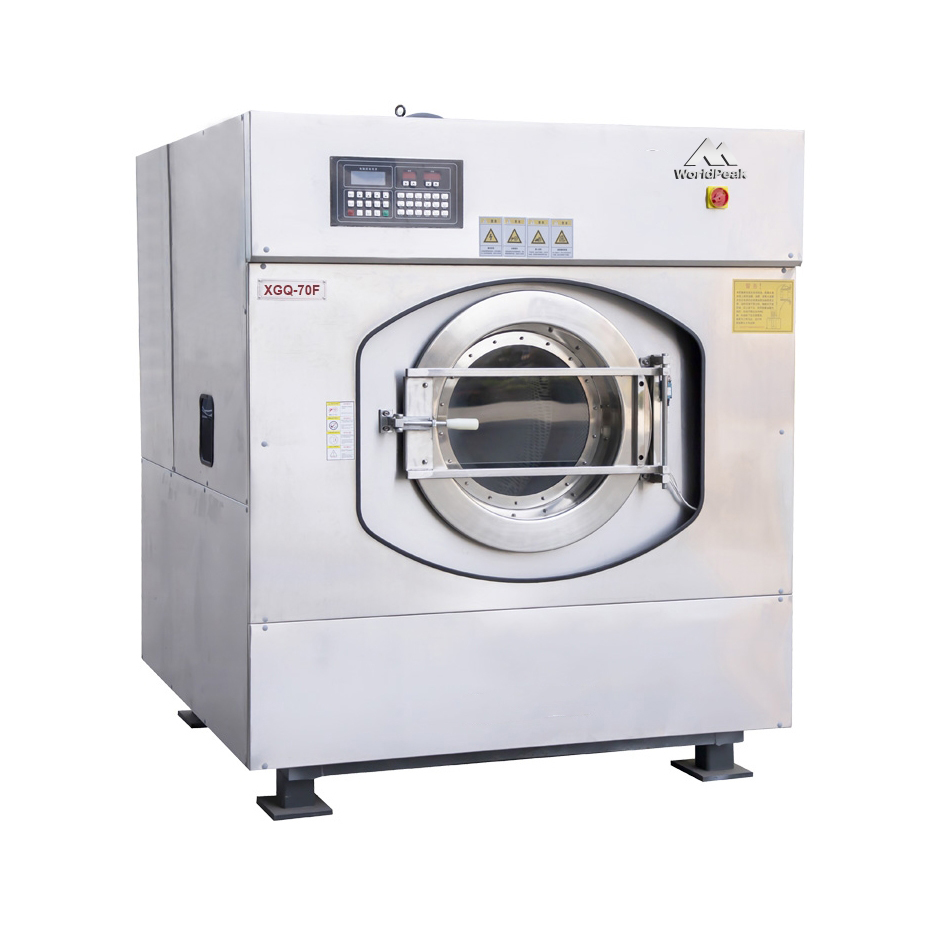

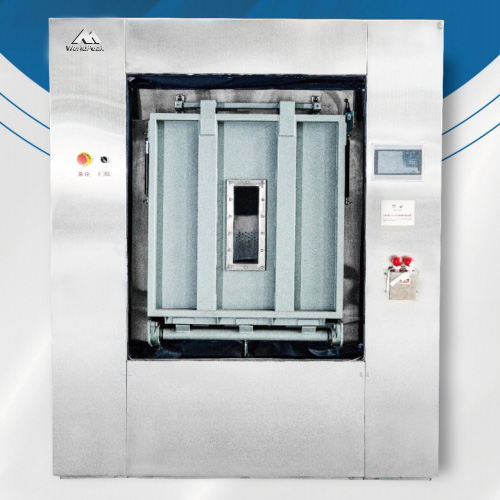
GLX Series Hygienic barrier washer-extractors are primarily used in facilities with strict hygiene requirements. In environments that handle contaminated textiles, these machines can effectively prevent contaminants from spreading. They also play an important role in facilities that require high standards of cleanliness.
1) The drum, piping, and outer tub that comes into contact with wash water are all made of stainless steel to resist corrosion from laundry chemicals;
2) A suspension system with air springs and hydraulic dampers ensures smooth operation and low noise levels;
3) A dynamic weighing system measures the load weight to prevent structural damage caused by overloading;
4) A drum indexing mechanism with a pneumatic brake and proximity switch accurately positions the inner drum door for loading and unloading;
5) An optimized pneumatic system with a pressure sensor ensures operation within the proper pressure range, protecting the air springs and main structure;
6) Both the inner and outer door locks feature self-locking mechanisms for quick, convenient operation;
7) Comprehensive self-diagnostic and protective functions quickly identify the location and cause of faults, simplifying daily operation and maintenance;
8) The PLC includes multiple preset wash programs to accommodate different types of linen.
Hygienic barrier washer-extractors are primarily used in facilities with strict hygiene requirements. In environments that handle contaminated textiles, these machines can effectively prevent contaminants from spreading. They also play an important role in facilities that require high standards of cleanliness.
Applications extend beyond these settings to other environments that require separate handling of soiled and clean textiles. In facilities where textiles need frequent washing, these machines can improve operational efficiency while ensuring that hygiene requirements are met.
| Model | Unit | GLX-30 | GLX-50 | GLX-70 | GLX-100 | GLX-150 |
|---|---|---|---|---|---|---|
| Rated Capacity | kg | 30 | 50 | 70 | 100 | 150 |
| Drum Volume | Lt | 301 | 506 | 705 | 1000 | 1500 |
| Motor Power | Kw | 4 | 5.5 | 7.5 | 11 | 22 |
| Washing Speed | r/min | 40 | 40 | 40 | 30 | 30 |
| Distribution Speed | r/min | 60 | 60 | 60 | 60 | 60 |
| Medium Extract Speed | r/min | 340 | 340 | 340 | 340 | 340 |
| High Extract Speed | r/min | 680 | 680 | 650 | 650 | 650 |
| Steam Pipe | - | 20(G3/4") | 20(G3/4") | 20(G3/4") | 20(G3/4") | 20(G3/4") |
| Cold/Hot Water Pipe | mm | 40(G1 1/2") | 40(G1 1/2") | 40(G1 1/2") | 50(G2") | 50(G2") |
| Compressed Air Pipe | mm | 8 | 8 | 8 | 8 | 8 |
| Compressed Air Pressure | Mpa | 0.5-0.6 | 0.5-0.6 | 0.5-0.6 | 0.5-0.6 | 0.5-0.6 |
| Water Consumption | Kg | 1000 | 1200 | 1250 | 1800 | 2200 |
| Steam Consumption | Kg | 22 | 30 | 45 | 50 | 75 |
| Power Consumption | Kwh | 1.8 | 2.1 | 2.8 | 3.2 | 5 |
| Compressed Air Flow | m²/min | 0.36 | 0.36 | 0.36 | 0.36 | 0.36 |
| Four-Core Copper Cable | mm | 4 | 6 | 6 | 10 | 12 |
| Overall Dimensions (L×W×H) | mm | 1325×1455×1725 | 1700×1450×1800 | 2000×1450×1900 | 2230×1450×2000 | 2550×1650×2200 |
| Machine Weight | kg | 1380 | 1800 | 2400 | 2800 | 3700 |
How does a hygienic barrier washer-extractor differ from a conventional washer-extractor?
A hygienic barrier washer-extractor features a dual-door barrier design, allowing textiles to be loaded from the soiled side and unloaded from the clean side to prevent cross-contamination. Conventional washer-extractors typically have a single door and cannot provide the same strict separation between soiled and clean areas.
Where are hygienic barrier washer-extractors commonly used?
These machines are primarily used to process laundry for hospital operating rooms and intensive care units (ICUs), pharmaceutical cleanrooms, food processing plants, laboratories, and other facilities with specific microbial control requirements. They are also suitable for certain upscale hotels and laundry facilities.
Is a higher extraction speed always better for a hygienic barrier washer-extractor?
Not necessarily. Excessively high speeds place greater demands on the suspension system and structural strength and may damage certain textiles. Select an extraction speed based on the type of linen and subsequent drying requirements. Typical industrial models operate at extraction speeds of 800–1,200 rpm.
What technical support services do manufacturers provide?
Most manufacturers provide installation guidance, operator training, scheduled maintenance reminders, and remote troubleshooting. Some also offer laundry layout planning recommendations to help users make efficient use of available space and meet requirements for separating soiled and clean areas.
Prev: XGQ-F Series Fully Automatic Washer-Extractor
Next: N/A