When operating a hotel with 100 guest rooms, linen laundering is an unavoidable major expense. Hotel managers setting up an in-house laundry often make one of two mistakes: buying oversized equipment that sits underused and wastes water and electricity, or choosing machines that are too small to keep up during peak season. The latter forces them to outsource overflow loads at short notice, increasing costs and making quality harder to control.
A 100-room hotel sits between a small guesthouse and a large hotel. With the right equipment, savings on laundry charges can cover the investment in two to three years. With the wrong setup, you pay every day for idle capacity and inefficient operations. This article explains how to equip a laundry for a 100-room hotel, step by step, from calculating laundry volumes and selecting machines to choosing heating methods, allocating the budget, and avoiding common mistakes.
How Much Linen Does a 100-Room Hotel Need to Wash Each Day?
The first step in selecting equipment is to calculate average daily laundry volume accurately, rather than starting with models and prices. Choosing machines by guesswork often leads to either excess capacity or a shortage.
A common industry estimate is 3–4 kg of dry linen per occupied room per day, covering a complete set of sheets, duvet covers, pillowcases, bath towels, face towels, and bath mats. At an average occupancy rate of 80%, a 100-room hotel generates approximately 240–320 kg of laundry per day. During peak season, full occupancy can push this above 350 kg, while low-season volumes may be around 200 kg.
An industrial washer-extractor can complete 4–6 full cycles per day. With an average daily load of 300 kg and 5 cycles a day, a single machine with a rated capacity of 60 kg can meet basic demand.
However, to allow for peak-season loads, equipment downtime, and separate washing of different linen categories, a more reliable setup is two 50 kg washer-extractors,
or one 100 kg unit with a smaller backup machine.
Recommended Reading:Costs and Profits of a Commercial Laundry Processing 1,000 Hotel Linen Sets per Day
How to Choose the Core Equipment
A complete hotel laundry relies on three core types of equipment: washer-extractors, tumble dryers, and flatwork ironers. Each handles a different stage of linen processing.
Washer-Extractors: The Heart of the Laundry Line
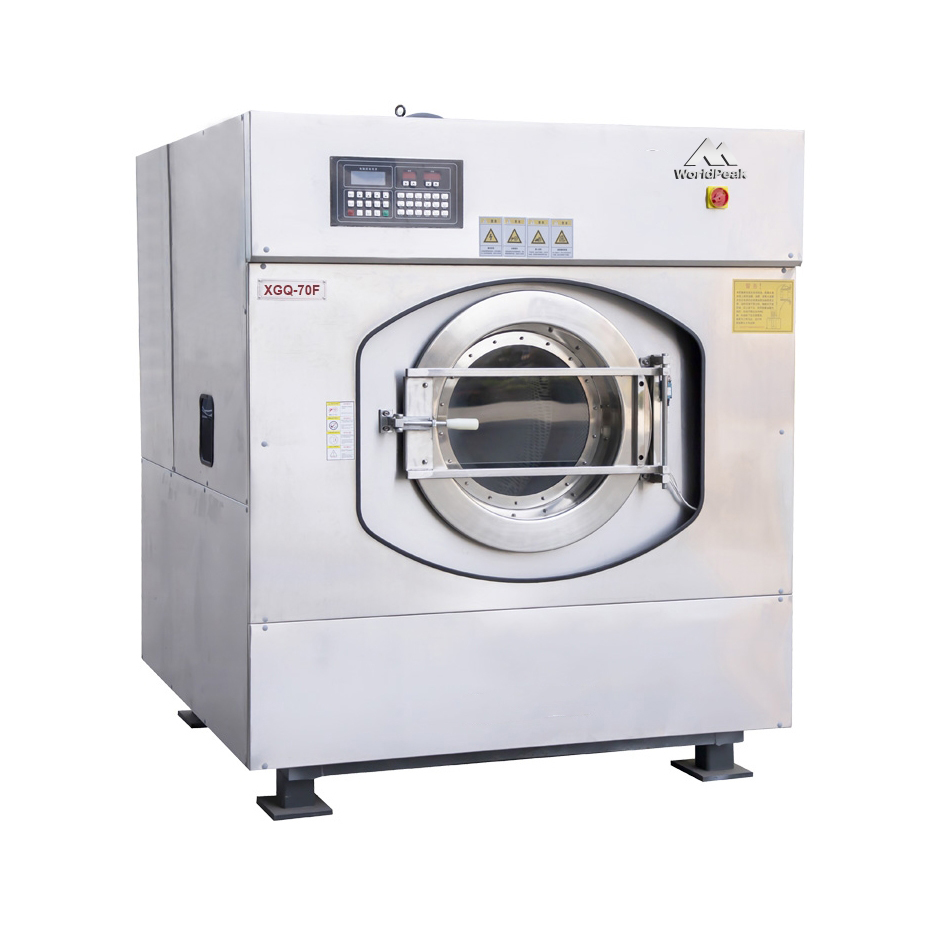
Washer-extractors handle washing, rinsing, and spin extraction, making them essential to both throughput and cleaning quality. For a 100-room hotel, there are two common configurations:
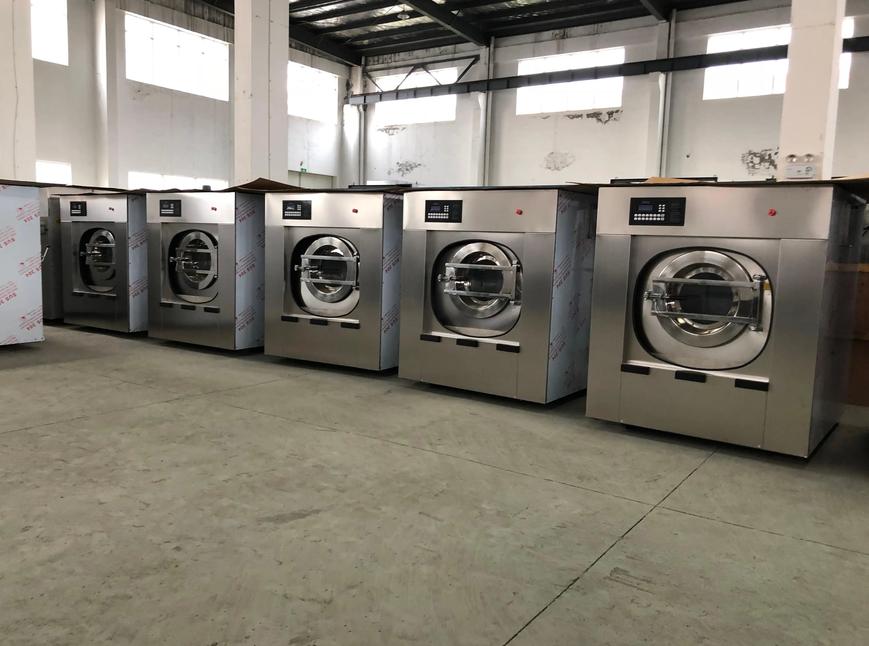
Option A: Two 50 kg Washer-Extractors. This is the most recommended flexible setup. Two 50 kg machines can operate in parallel, with just one running for everyday demand and both running during peak season. If one breaks down, the other can keep operations going. You can also wash towels and sheets separately to prevent color transfer. A fully automatic 50 kg washer-extractor costs approximately $8,000–$15,000. Mainstream Chinese brands are around $10,000, while imported brands cost more than twice as much.
Option B: One 100 kg Washer-Extractor. This suits hotels with limited space and a small team. Processing everything in one large machine simplifies operation and reduces the footprint. The drawback is that a breakdown stops the entire line. Small loads also require running the whole machine, resulting in substantial water and electricity waste. A 100 kg washer-extractor costs approximately $15,000–$28,000.
Whichever option you choose, prioritize models with a fully suspended vibration-isolation system. They do not require floor anchoring bolts and can also be installed on the second floor, with much less vibration and noise to avoid disturbing guest rooms below.
Tumble Dryers: For Towels and Bath Mats
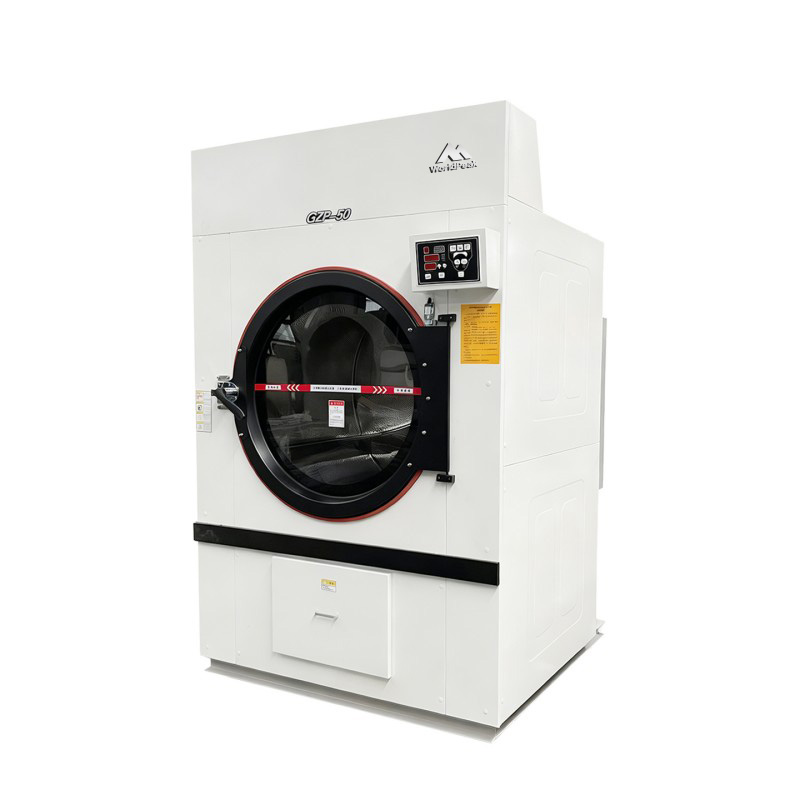
Sheets and duvet covers are dried and smoothed by the flatwork ironer, while bulky textiles such as towels, bath towels, and bath mats need a tumble dryer.
Dryer capacity should be slightly larger than washer-extractor capacity because linen becomes bulkier after spin extraction. Pair a 50 kg washer-extractor with a 50–70 kg dryer, and a 100 kg washer-extractor with a 100–120 kg dryer. A typical 100-room hotel uses 1–2 dryers with a capacity of 50 kg each, costing $7,000–$18,000 per unit.
Check two key features when choosing a dryer. First, automatic moisture sensing should stop the machine once the target dryness is reached, preventing overdrying and heat damage to towels. Second, the drum should be made of 304 stainless steel, with smoothly finished perforation edges. Rough edges can snag fibers and quickly cause towels to fray and wear out.
Flatwork Ironers: The Key to Linen Presentation
After washing, sheets, duvet covers, and pillowcases need a flatwork ironer to dry and smooth them at the same time. This is crucial to the appearance of hotel linen. Many small hotels use tumble dryers for sheets to save effort, only to end up with wrinkles and a poor guest experience.
For a 100-room hotel, one single-roll or double-roll flatwork ironer is sufficient. Choose a roller length of 2.8 meters or 3.0 meters to accommodate even the largest duvet covers. A single-roll steam-heated ironer costs approximately $9,000–$18,000, while a double-roll model costs $18,000–$35,000. Double-roll machines are more efficient but cost about twice as much. A single-roll model generally meets the needs of a 100-room hotel; choose a double-roll model if greater efficiency is the priority.
If the budget is limited and linen volumes are modest, a small ironing table can serve as a temporary solution. However, manual ironing is slow and produces inconsistent results. It is suitable only as a stopgap; a professional flatwork ironer is recommended for long-term operation.
Add Supporting Equipment as Needed
Beyond the three main machines, supporting equipment can be added according to your budget and staffing:
Automatic folding machine: Works with the flatwork ironer to fold sheets and duvet covers automatically, reducing staffing needs by 1–2 people. Prices range from $12,000–$40,000, making it particularly worthwhile where labor costs are high.
Linen carts and sorting tables: Basic supporting equipment costing from a few hundred to a few thousand dollars.
Water-softening system: Essential in hard-water areas. It protects equipment against scale, reduces detergent consumption, and leaves linen softer.
How to Choose a Heating Method
The heating method directly affects operating costs and installation complexity, making it an important equipment selection decision.
Steam Heating: The Preferred Option for Medium and Large Hotels
Steam is the most widely used heating method in the hotel industry and can be used for both washer-extractors and flatwork ironers. If the hotel already has a boiler for its central air-conditioning or hot-water system, simply connect the steam piping for the lowest operating costs.
The advantages include even heating, stable temperatures, less risk of linen yellowing, and greater safety because there is no open flame. The drawback is that a steam supply is required. Installing a small dedicated steam boiler for the laundry adds another $8,000–$20,000 and requires a dedicated operator.
Electric Heating: Suitable for Small Operations and Limited Space
Electrically heated equipment is less expensive to buy and easy to install. It only needs a 380V three-phase power connection, with no piping or boiler approvals required.
However, its operating costs are the highest of the three options, with electricity typically costing 2–3 times as much as steam. It is suitable only for small hotels with modest daily laundry volumes and no access to steam or gas. For a 100-room hotel running electrically heated equipment at full capacity, monthly electricity bills can be substantial.
Gas Heating: A Practical Alternative When Steam Is Unavailable
Direct-fired natural gas heating warms up quickly and dries efficiently, with much lower operating costs than electric heating. In areas with inexpensive gas, it can even cost less than steam. No boiler is required, eliminating boiler approval and operator costs.
The disadvantages are the need for a gas connection, demanding installation requirements, and exhaust ventilation. Poor heat control can cause localized overheating and yellow towels. If the hotel has natural gas but no steam supply, a gas-heated dryer offers excellent value.
In summary, choose steam if a steam supply already exists, gas if natural gas is available, and electric heating only if neither is available and laundry volumes are modest.
What Is the Laundry Budget for a 100-Room Hotel?
Many buyers budget only for the equipment and overlook installation, renovation, and supporting systems, resulting in substantial overspending. The following provides a complete budget reference based on standard configurations from mainstream Chinese brands.
Basic Practical Setup (Total Budget: Approximately $50,000–$70,000)
1 fully automatic 50 kg washer-extractor: $9,000–$12,000
1 dryer with a capacity of 50 kg: $7,000–$10,000
1 single-roll flatwork ironer: $9,000–$15,000
Supporting equipment and consumables: $3,000–$5,000
Installation, plumbing and electrical upgrades, and transport: $8,000–$15,000
Licenses, permits, and environmental impact assessment: $2,000–$5,000
Working capital: $12,000–$18,000
Suitable for midscale hotels with lower occupancy rates and limited budgets. It can handle everyday operations, although overtime may be needed during peak season.
Standard Reliable Setup (Total Budget: Approximately $80,000–$120,000)
2 fully automatic 50 kg washer-extractors: $18,000–$24,000
2 dryers with a capacity of 50 kg each: $14,000–$20,000
1 double-roll flatwork ironer: $18,000–$28,000
Water-softening system + supporting equipment: $5,000–$8,000
Installation, renovation, and transport: $10,000–$20,000
Licenses, permits, and working capital: $15,000–$20,000
This is the most recommended setup for a 100-room hotel. The two washer-extractors back each other up, and the double-roll ironer provides ample throughput to handle peak season comfortably, with better overall service life and reliability.
Premium Fully Automated Setup (Total Budget: Approximately $150,000 or More)
Add an automatic folding machine, automatic chemical dosing system, conveyors, and other equipment to the standard setup to further reduce labor and improve consistency. This suits upscale hotels and properties with exceptionally demanding linen quality standards.
Imported equipment typically costs 2–3 times as much as Chinese-made equipment. Although quality and reliability are better, the payback period is also much longer. For most hotel chains and midscale hotels, a reliable Chinese brand is sufficient.
Site and Installation Considerations
Buying equipment only to discover that it cannot fit into the building or be put into operation is a common beginner's mistake. Assess site conditions thoroughly before purchasing.
First, consider space requirements. A laundry for a 100-room hotel needs 60–80 square meters of usable floor area, divided into areas for soiled linen, washing, clean linen, and finished linen storage. Leave room for staff movement and equipment maintenance. The ceiling height should be at least 3 meters, and both the ironer and dryers need space for exhaust ventilation.
Second, check access dimensions. Industrial machines are bulky, so measure the width and height of elevators, corridors, and doorways in advance to ensure the equipment can be brought in. Many older hotels have small elevators, meaning equipment must be moved up the stairs or lifted into place by crane, adding to the cost.
Third, check utilities. Confirm that the 380V three-phase electrical supply has sufficient capacity, steam and gas piping can be connected, and drainage pipes are large enough. Unless these requirements are addressed in advance, the equipment cannot operate even after delivery.
Finally, consider environmental requirements. Local authorities now regulate laundry wastewater discharge, so basic wastewater treatment facilities are required to meet discharge standards. This is not an expense to cut: inspections followed by corrective work or shutdowns can lead to greater losses.
Purchasing Pitfalls to Avoid
Looking Only at Price and Ignoring Specifications
Prices for 50 kg washer-extractors can differ by several thousand dollars. What accounts for the difference? Whether the drum uses 201 or 304 stainless steel, whether the motor uses fixed-speed or variable-frequency control, whether the machine is hard-mounted or fully suspended, and whether the sheet metal is thick enough. Low-cost machines often cut corners in these less visible areas, developing problems after a year or two. Once repair costs are added, they can end up being more expensive.
Choosing Large Capacity Without Assessing Demand
Bigger equipment is not always better. Installing two 100 kg machines in a 100-room hotel and routinely filling them only one-third full wastes water and electricity with every cycle. The setup may appear to offer plenty of capacity, but it creates daily waste. A reserve of 20%–30% is sufficient for peak season; additional capacity is a sunk cost.
Mismatched Equipment Throughput
The throughput of the washer-extractors, dryers, and flatwork ironer should be matched. For example, if a washer-extractor produces one 50 kg batch per hour, the dryer should finish that load within an hour, and the ironer should process it within an hour as well. If washing is fast but ironing is slow, linen piles up at the ironing stage, and the slowest machine limits the efficiency of the entire line.
Overlooking After-Sales Service and Spare Parts
Purchasing industrial equipment is only the beginning; ongoing maintenance matters. Prioritize suppliers with local service centers that can provide on-site repairs within 24 hours of a breakdown. Spare parts for obscure brands can be hard to find. Waiting two weeks for one component can disrupt the hotel's linen turnaround, causing losses far greater than the difference in equipment prices.
When equipping a laundry for a 100-room hotel, the goal is not to buy the most expensive or largest machines, but to match your occupancy rate, site conditions, and available energy sources. Calculate daily laundry volumes first, determine the equipment combination, choose the appropriate heating method, and account for installation, renovation, and after-sales service to make a truly cost-effective decision.
The benefits of an in-house laundry go beyond saving money. More importantly, it gives you control over linen quality, flexible turnaround, and greater assurance of a good guest experience. With the right equipment, the investment can pay for itself in two to three years, followed by direct savings on operating expenses every year. Over the long term, it is a worthwhile investment.